The federal
Clean Water Act (CWA) protects the nation’s waters. It sets requirements for each state to develop programs to address water pollution, including:
- Establishment of water quality standards.
- Implementation of water quality monitoring programs.
- Identification and reporting of waters that are designated as ‘impaired’ when applicable water quality standards are not met.
- Establishment of
Total Maximum Daily Loads (TMDLs), a tool that sets pollution limits to maintain applicable water quality standards for impaired waters.
- Development of maximum pollutant loads (waste load allocations) for wastewater treatment facilities and some stormwater discharges to maintain water quality standards.
The
U.S. Environmental Protection Agency (EPA) implements these standards through the
National Pollutant Discharge Elimination System (NPDES) program, which regulates potential pollutant sources that can be traced to a specific location, referred to as ‘point’ sources. The
Maryland Department of the Environment (MDE) has delegated authority from EPA to issue NPDES discharge permits within Maryland. The Maryland Department of Transportation State Highway Administration (SHA) is covered under a Phase I, individualized NPDES Municipal Separate Storm Sewer System (MS4) permit. An NPDES MS4 permit will be issued by MDE for a 5-year term to entities that own and operate large-scale infrastructure used to collect or transport stormwater (e.g., ponds, storm drains, pipes, ditches, outfalls). Stormwater is the term used by EPA for rainwater or melted snow that runs/drains off streets, lawns, and other sites.
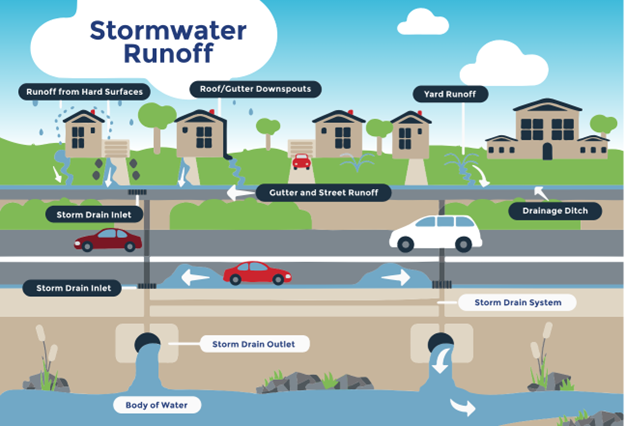
Graphic from City of Newport News webpage:
Stormwater Management | Newport News, VA - Official Website
SHA implements efforts statewide to comply with conditions in its NPDES MS4 permit and reports these activities to MDE on an annual basis. All SHA annual reports for a given five-year NPDES MS4 permit term are posted for public access at the page linked above. When EPA establishes new TMDLs and MDE assigns SHA a wasteload allocation, SHA develops an applicable TMDL Implementation Plan for its intended efforts to improve water quality. SHA encourages public participation in SHA planning for water quality restoration activities and will advertise a public comment period for any new TMDL Implementation Plan it develops. Information about public comment periods can be found on the
SHA TMDL Implementation Plan Public Notice and Participation page. The SHA Office of Environmental Design, Water Programs Division acts as liaison to MDE and the public for issues, questions, and concerns related to SHA administration of compliance activities for its NPDES MS4 permit. You can use the following contact information to reach the Water Programs Division:
Ryan Cole, PWS, Chief of Water Programs Division
Email:
[email protected]
To reduce the primary pollutants impairing waters of the Chesapeake Bay (i.e., nitrogen, phosphorus and sediment), SHA implements various types of Best Management Practices (BMPs) that have been approved by experts at the Chesapeake Bay Program and by MDE for that purpose. Visit the
SHA Bay Restoration Strategies page for more information about SHA restoration BMPs. You can also visit the
SHA Chesapeake Bay Restoration Viewer page for an interactive tool showing restoration BMPs completed by SHA since 2010 to improve water quality in the Chesapeake Bay.
SHA works to educate the public about ways to reduce pollutants entering waterways through erosion control, proper disposal of vehicle fluids, programs to stop roadside dumping and more. Visit the
page linked above for more details.